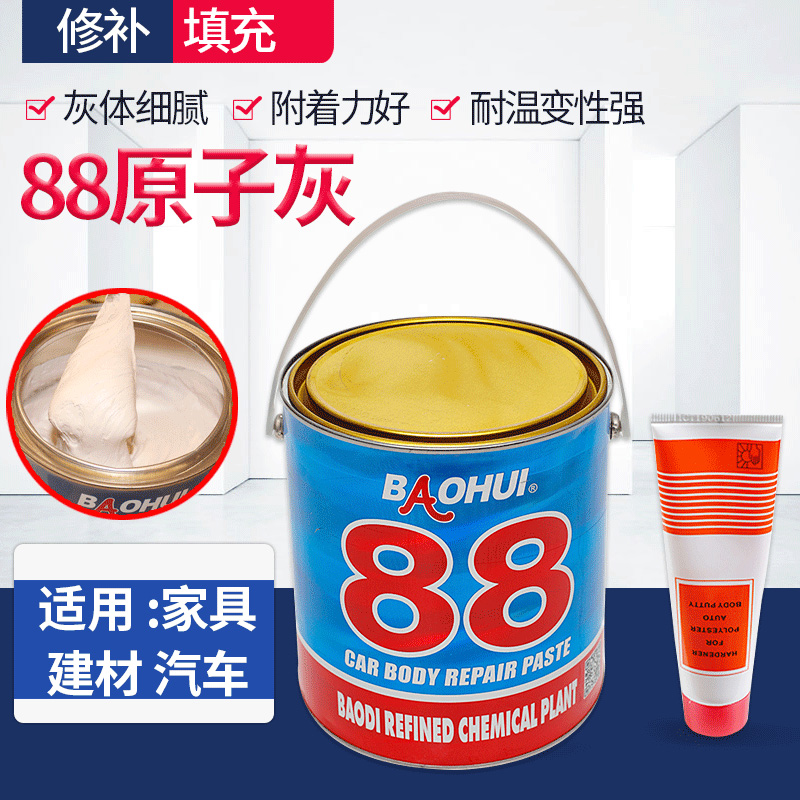
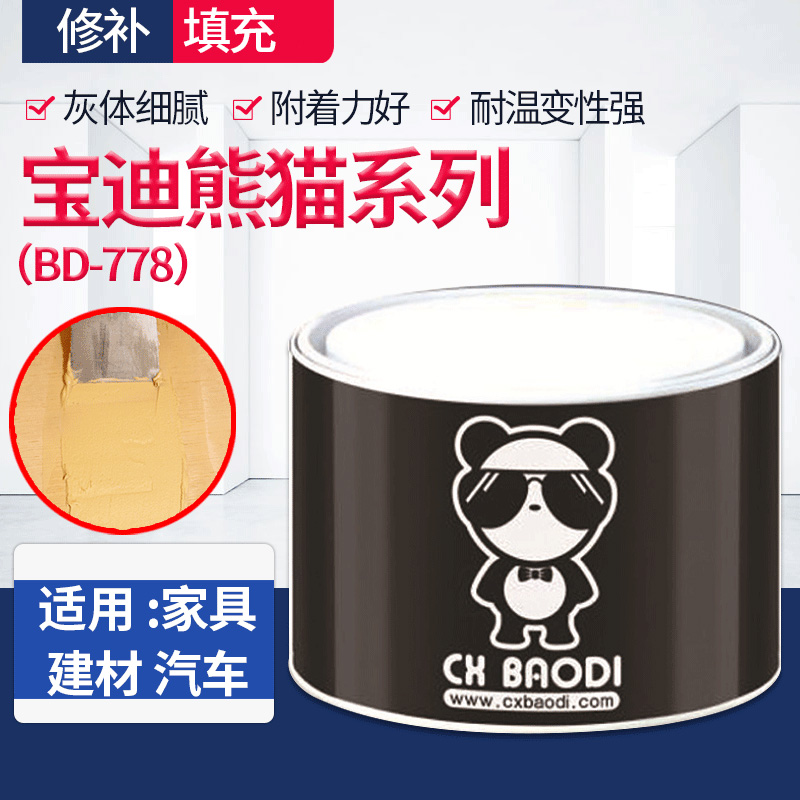
Your current position: Home >> What are some common problems encountered during putty application? Your current position: Home >> What are some common problems encountered during putty application?What are some common problems encountered during putty application?Published by:2026-2-4 Categories:Industry news Viewed by: 196 times Putty, a general term for unsaturated polyester resin putty, consists of a two-component system: the main body putty and the curing agent. The main body putty is based on unsaturated polyester resin, combined with fillers such as talcum powder and calcium carbonate, and styrene diluent. The curing agent contains a cobalt salt initiator and a plasticizer, achieving rapid polymerization and curing through a precise ratio of 100:1.5~3. This chemical structure endows it with fast-drying characteristics at room temperature, allowing surface curing to be completed within minutes after mixing.
Common problems in putty application mainly include bubbling, cracking, peeling, sagging, color bleeding, and difficulty in sanding, which directly affect the final coating effect and durability. The following are six common construction problems, their causes, and corresponding solutions summarized based on industry practice. 1. Bubbling (bulges, bubbles) This is one of the most common defects in putty application, manifested as raised bubbles on the surface of the paint film or putty layer. Main causes: Applying putty before it is completely dry or baking at high temperatures, causing internal moisture or solvents to vaporize upon heating. Residual oil stains, water stains, or incomplete cleaning of the substrate, leading to poor adhesion. Using ordinary-type putty in high-temperature environments without selecting high-temperature-resistant products. Applying putty when the air humidity is too high or the substrate is not fully dried after water sanding. Solutions: Ensure that the putty is completely cured before proceeding to the next process; Thoroughly remove oil, water, and sand the substrate before application; Use dedicated high-temperature-resistant putty in high-temperature environments; Control the humidity of the construction environment and avoid working during rainy seasons or plum rain days.
2. Cracking (chapping, cracks) The putty layer exhibits fine cracks or even large-scale cracking, affecting structural strength and appearance. Main causes: Applying too thick a layer in one go, leading to inconsistent drying speeds inside and outside, resulting in stress cracking. Using inferior putty or an improper ratio of curing agent (too little or too much). The substrate is made of high-shrinkage materials such as wood, causing cracking due to thermal expansion and contraction. Rapid cooling after high-temperature baking, resulting in thermal shock. Solution: Adopt the principle of "thin scraping with multiple layers", with each layer not exceeding 2-3mm in thickness; Strictly follow the 100:2 ratio for adding curing agent and mix them evenly; For substrates prone to deformation, use flexible putty or apply multiple thin scrapes; Allow natural cooling after baking, avoiding forced cooling.
3. Peeling (delamination, detachment) Loss of adhesion between the putty and the substrate or coating, resulting in the entire piece peeling off. Main causes: The substrate is not cleaned thoroughly, with oil stains, rust, old paint film, or dust present. Using an incompatible primer or not performing a roughening treatment, leading to poor interlayer adhesion. Failure or insufficient addition of curing agent, resulting in insufficient crosslinking. Directly touching the workpiece after phosphating or electrophoresis with hands, leaving sweat stains that affect adhesion. Solution: Thoroughly clean the substrate, using a degreaser or 93# gasoline for cleaning; Sand the old paint surface and perform a texturing treatment to enhance adhesion; Use a curing agent within its expiration date, mixed according to the standard ratio; Wear gloves during operation to avoid bare-handed contact with the treated surface.
4. Sagging (flowing, drooping) Putty flows downward due to gravity on vertical surfaces or corners, forming uneven accumulations. Main reasons: Applying too thick a layer at once, with excessive paint accumulation in some areas. Irregular scraping operation, with slow moving speed or prolonged dwell time. Putty viscosity is too low or the ambient temperature is too high, enhancing fluidity. Solution: Adhere to the principle of "thin coating, multiple coats," controlling the thickness of each coat; Apply a thin layer horizontally on vertical surfaces first, then tidy up vertically, and spot-apply and extend at corners and edges; Adjust the temperature and humidity of the construction environment to avoid working at high temperatures.
5. Bleeding (discoloration, color spots) Color migration occurs under light-colored topcoats, especially in silver powder paints, manifesting as cloudy color differences. Main reasons: The curing agent in the putty contains oxides, bleaching or contaminating the topcoat paint. Using poor-quality putty containing easily precipitated components. The putty and topcoat systems are incompatible and have not undergone compatibility testing. Solution: Choose high-quality, low bleeding risk putty; Apply a sealing primer (such as epoxy primer) on the putty layer for isolation; Conduct a small sample test before construction to confirm compatibility.
6. Difficulty in sanding (hard to sand, rough) The dried putty is difficult to sand, resulting in a rough surface or many sand holes. Main reasons: Dry sanding before the putty is fully dry, leading to stickiness or fuzzing. Using low-grade putty or inferior sandpaper, with poor filling properties. Mixing in bubbles or improper scraping techniques, leading to many sand holes. Solution: Wait for the putty to fully cure before sanding (usually for more than 20 minutes); Use high-hardness, fine-grained high-quality putty and sandpaper; Improve scraping techniques to avoid entrapped air, and use hole-filling putty to repair pinholes if necessary.
|

 |
 |
About us |
|
Product Categories | |
Contact way Address: 268 Hongchang Road, Changxing County, Huzhou City, Zhejiang Province |
| Copyright © 2020 Changxing Baodi Environmental Protection Technology Co., Ltd all reserved | Web Admin --> >> |



 Home
Home